

Prerequisites
- Docker installed on your server — Install Docker
- Access to a MongoDB instance (on-premise or cloud-hosted, e.g., MongoDB Atlas)
- SMTP credentials from any email provider (SendGrid, Gmail, custom SMTP, etc.)
System Requirements
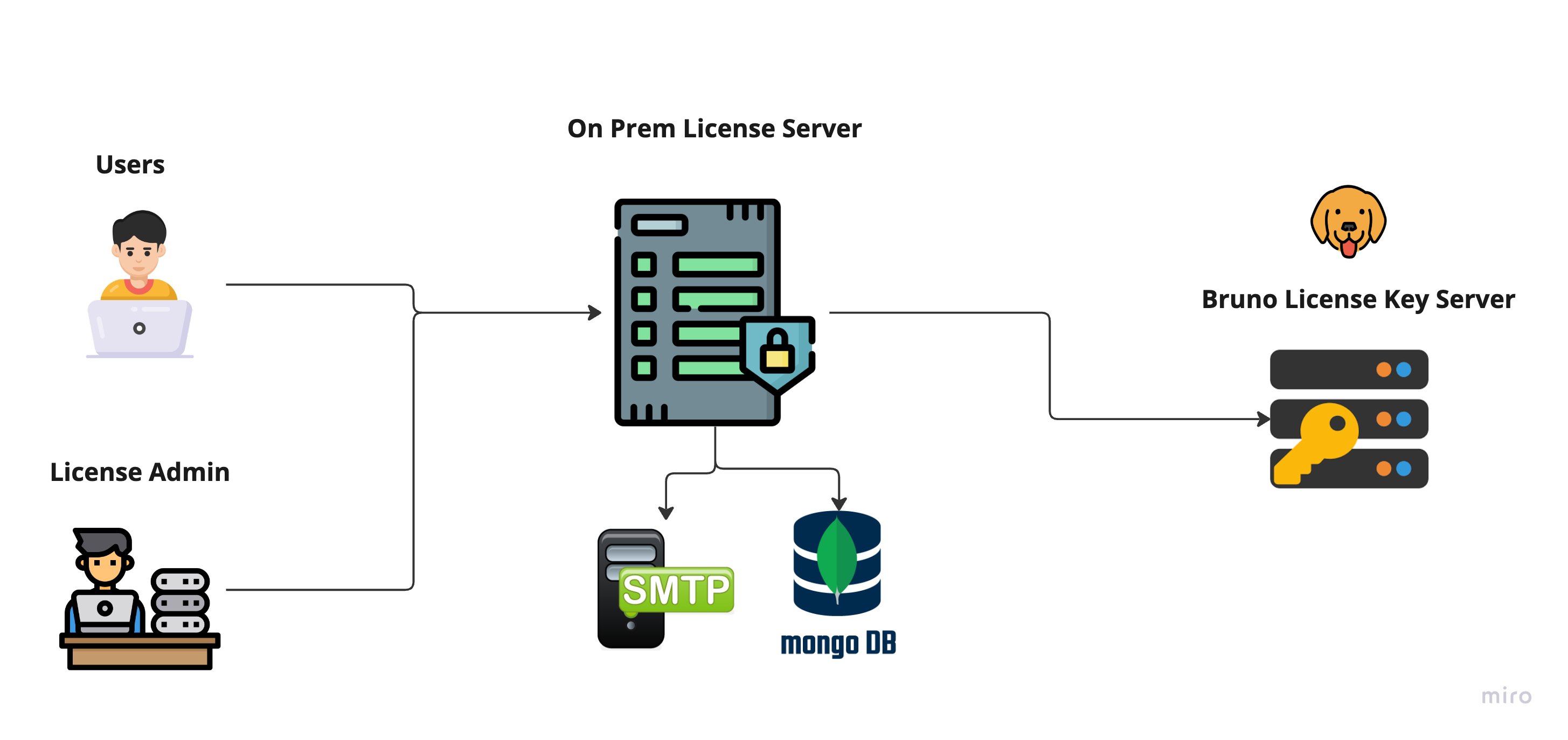
Architecture Diagram
Setup Methods
The licensing server can be deployed in four ways. Choose the approach that fits your infrastructure:1. Setup by Running the Docker Image
Pull the image:2. Setup Using Ansible
3. Setup Using Docker Compose
docker-compose.yml:
4. Setup Using Kubernetes
Create the secret:licensing-server.yaml — Deployment and Service:
Network Ports & Firewall Rules
Proxy Settings
Pass the following environment variables to configure proxy settings:Troubleshooting SSL Issues
The following environment variables disable SSL validation when connecting to the Bruno Global Licensing Server.SSL Configuration
The licensing server supports SSL using either a self-signed certificate or a CA-signed certificate. Supported formats:- PFX format (
.p12) - CRT + KEY format (
.crtand.key)
SSL_KEY_PASSPHRASE is optional and only required if the certificate is encrypted.
Expected file structure:
Email Configuration
The licensing server supports customizable email templates for license activation, deactivation, and OTP-based login.Template Format
Templates are written in TOML format with two required fields:
Example template:
Available Template Variables
Template File Structure
Mount your custom templates using the following structure:
Mount templates when starting the container:
Template Fallback Behavior
If a custom template is missing or cannot be parsed, the server automatically falls back to the default Bruno template for that notification type. Template usage and fallback events are logged at startup and runtime.Built-In Template Examples
License Activation (license-activation.toml)
License Activation (license-activation.toml)
License Deactivation (license-deactivation.toml)
License Deactivation (license-deactivation.toml)
OTP Login (otp-email.toml)
OTP Login (otp-email.toml)
Troubleshooting Template Issues
Template not being used:- Verify the file exists at
/opt/license-service/templates/[template-name].toml - Check file permissions (must be readable by the container)
- Confirm the server logs show the template was loaded
- Verify valid TOML syntax
- Ensure both
subjectandbodyfields are present - Use Mustache-style variables (
{{variable}}), not${variable}
- Missing or misspelled
subject/bodyfields - Incorrect variable formatting
- Invalid HTML or character encoding
- Missing read permissions on the template file
SSO for License Admins
The licensing server supports Single Sign-On (SSO) via SAML, allowing License Administrators to log in through your organization’s Identity Provider (IdP).Environment Variables
Domain Discovery
Bruno supports domain discovery, which automatically routes users to your organization’s license server based on their email domain. To enable this, send us the following details:- Domain — e.g.,
company.com(as injohn@company.com) - Internal License Server URL — e.g.,
https://bruno.internal
User Workflow for License Activation via SSO
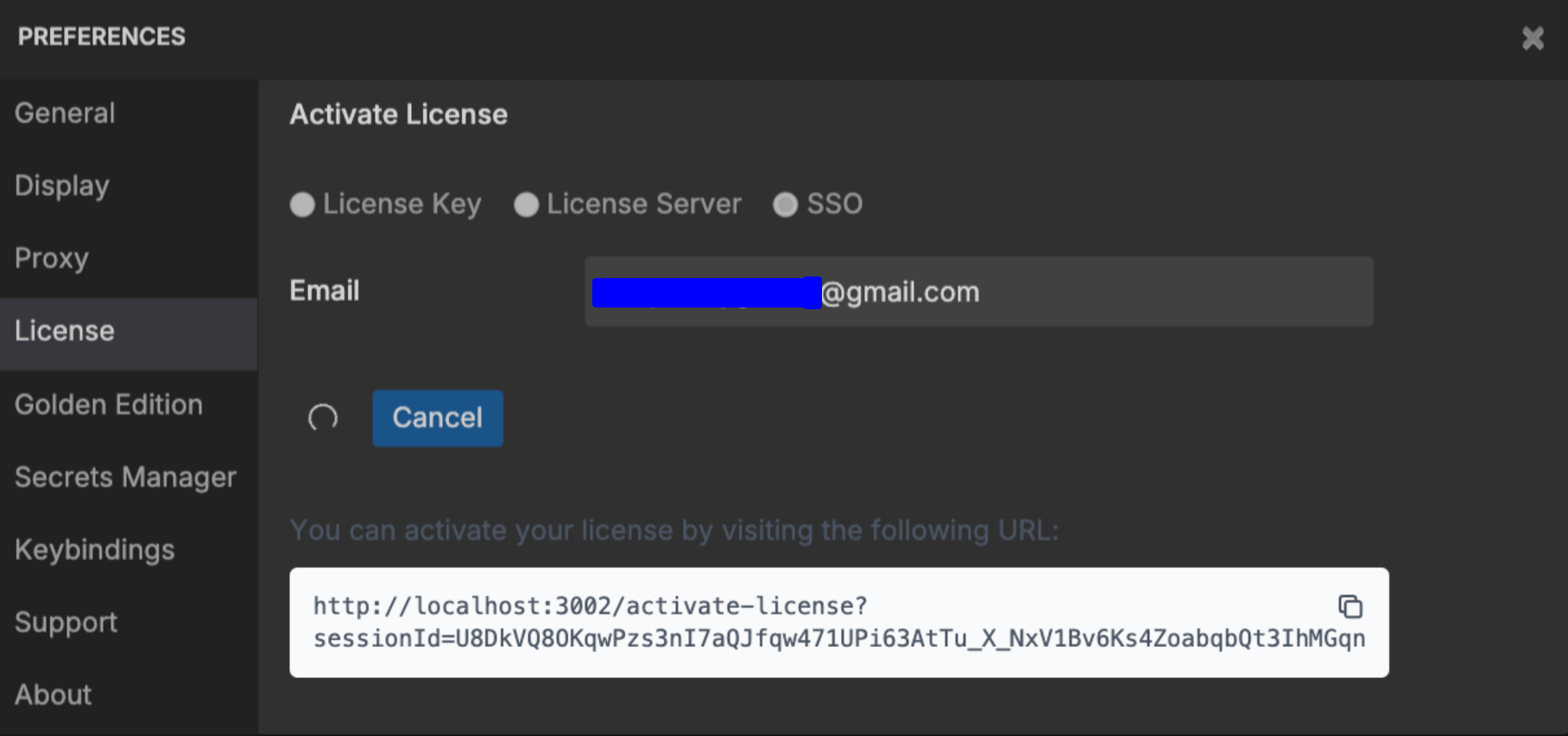
- Open the Bruno app, select the SSO option, and enter your work email.
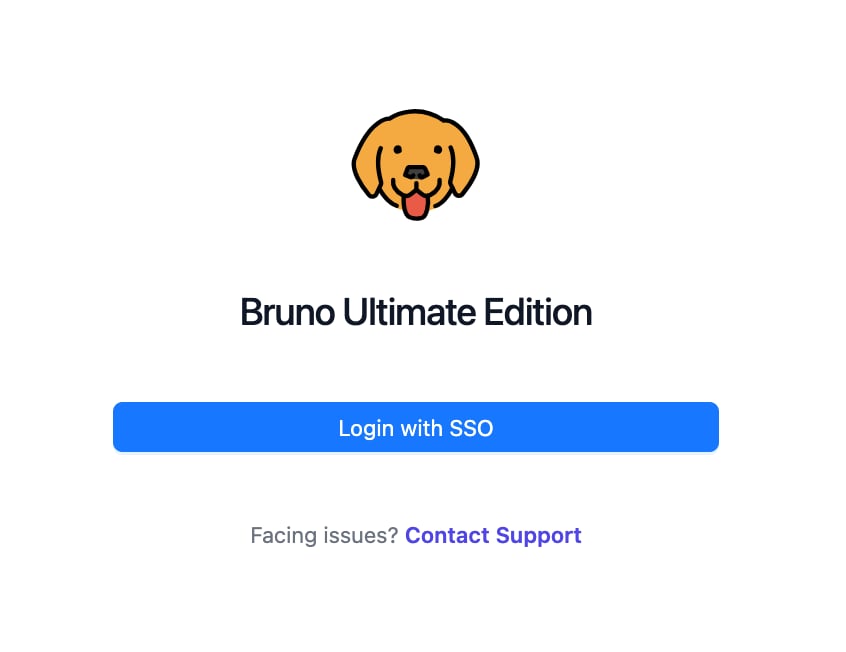
- You will be redirected to the SSO login page. If
SSO_ENABLED=true, a Login with SSO button will appear.
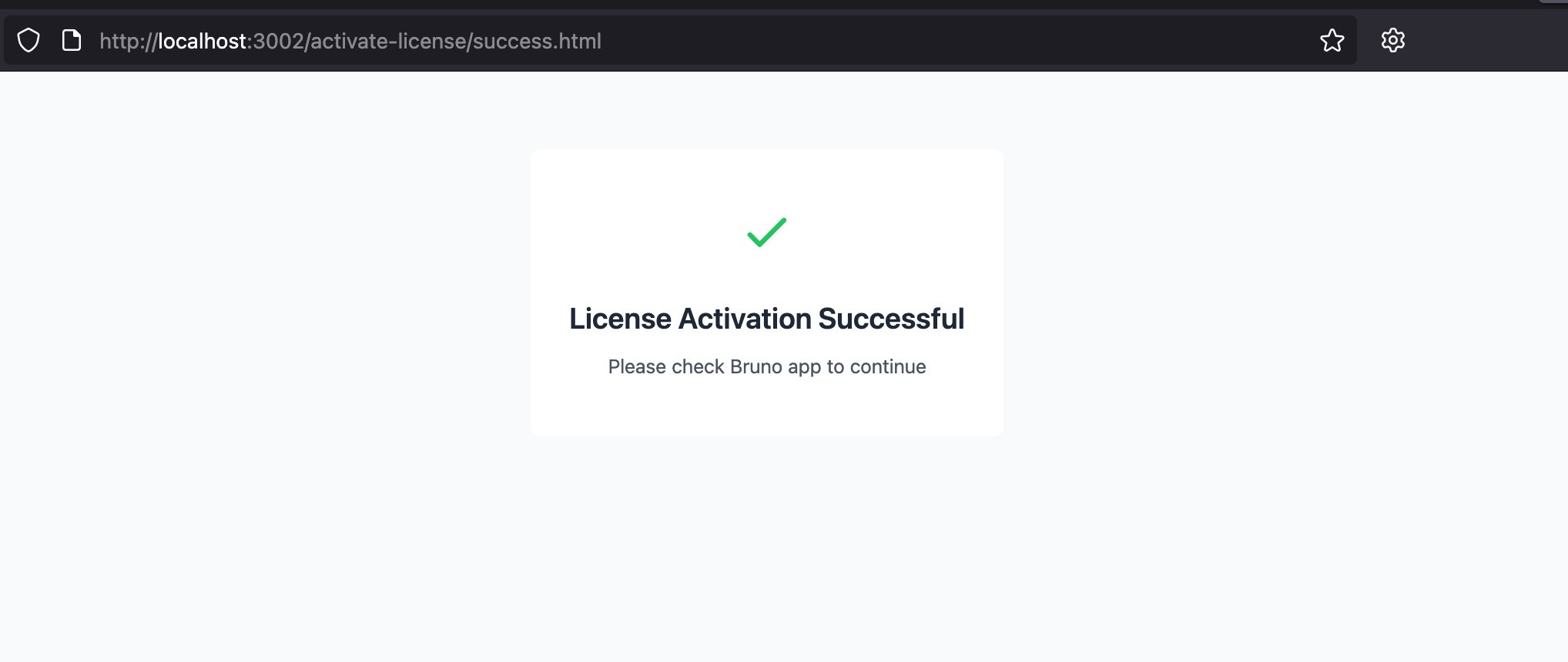
- After logging in through your IdP, users with the
bruno-license-userrole will be granted access and see the activation confirmation page.
Changelog
Release history for the Bruno Self-Hosted Licensing Server.1.17.0 (30 March 2026)
- Display the app version in the admin dashboard
1.16.2 (2 March 2026)
- Fixed issue where license activation details were not persisted after restarting the app
1.16.1 (19 February 2026)
- Fixed license activation issue
1.16.0 (6 February 2026)
- Added user activation logs
- Added dynamic version logs
- Fixed issue with Docker image updates for default templates
1.15.2 (16 January 2026)
- Fixed issue with Docker image updates
1.15.1 (14 January 2026)
- Fixed session handling for SSO
1.15.0 (9 January 2026)
- Added refresh option for the license information
1.14.0 (1 January 2026)
- Added CSV export support for user data
1.13.0 (4 November 2025)
- Added SCIM support in SSO integration for automated user provisioning and enhanced identity management
1.12.1 (17 October 2025)
- Fixed duplicate license activation page after successful login
1.12.0 (7 August 2025)
- Support for customizing License Activation, Deactivation, and OTP emails
1.11.0 (8 July 2025)
- Support for in-app license activation using SSO
- Users are now notified via email upon deactivation
1.10.1 (10 June 2025)
- Parse Group/Role attributes with list of values (SSO)
1.10.0 (29 May 2025)
- License keys are masked in the UI
- Seat usage is now displayed in the UI
1.9.3 (22 May 2025)
- Retrieve role info from Groups attribute and validate accordingly (SAML, SSO)
1.9.2 (9 May 2025)
- Made Assertion signature non-mandatory (Response signature is required) for SSO
1.9.1 (17 April 2025)
- Fixed issue related to duplicate user during upload
1.9.0 (4 April 2025)
- SSO support for License Admins
1.8.0 (28 March 2025)
- SSL certificate configuration support
1.7.0 (26 November 2024)
- Status API —
/api/v1/status